How to Proofread Your Own Writing
To proofread your own writing, put time between writing and checking, change how the text looks on the page, and then read it in separate passes, each looking for one kind of error. Read slowly, aloud or sentence by sentence from the end, and finish by searching for the mistakes you know you tend to make. A spell checker comes first, not last.
The method matters more than effort, because a writer's own errors are the hardest ones to see. The brain reads what it meant to write. The steps below are designed to break that habit, and they work as well on an email or a cover letter as on a dissertation.
Why your own errors are hard to see
A writer knows what each sentence is supposed to say, so the eye skims and the mind fills in. A missing "not" or a doubled "the" slips past because the meaning arrives before the words do. Someone reading the same page cold has no such shortcut and sees what is actually there.
That is why most advice on self-proofreading starts with distance. The UNC Writing Center recommends setting a paper aside for hours or days before checking it, and changing its size, spacing or font so the brain treats it as an unfamiliar document. Both tricks aim at the same thing, which is reading as a stranger would.
It also helps to keep editing and proofreading apart. Editing asks whether the argument, structure and wording work. Proofreading assumes they do and checks the surface for errors. Mixing the two means rewriting a paragraph and introducing a fresh typo in the process, so the proofread belongs at the very end.
A six-step method for proofreading your own writing
The method works because each pass has one job. Looking for everything at once means looking properly for nothing, so the passes are run in an order where each one leaves tidier text for the next.
- 1
Finish editing, then step away
Make the last content change, then leave the text for at least an hour, ideally overnight.
A settled text you no longer remember line by line - 2
Run the spell checker
Clear the obvious typos so they do not distract from the subtler ones.
- 3
Change how it looks
Switch the font and size, or print it, so the page no longer looks familiar.
- 4
Read for words
Read aloud, slowly, checking every word is present, correct and not repeated.
- 5
Read for consistency
Check names, numbers, dates, capitals and headings against each other.
- 6
Search for your known errors
Use the find function to hunt the mistakes you personally repeat.
Step 4 carries most of the weight, and reading aloud is what makes it work. Speaking each word forces the eye to stop on it, so dropped words and doubled ones become audible. The Purdue Online Writing Lab also suggests reading sentence by sentence from the end, which strips away the flow of the argument and leaves only the sentence in front of you.
A shorter version for emails and short pieces
Six passes on a three-line email would be absurd. For short pieces the method shrinks to three moves, and it still catches most of what matters. The order stays the same, because the logic of one job per pass still holds.
First, wait even a minute after writing, long enough to stop hearing the sentence in your head. Second, read it aloud under your breath, word by word. Third, check the details a reader acts on, which are the recipient's name, any dates, times or amounts, and whether the attachment is actually attached.
That last check earns its place. A typo in an email is a small embarrassment, but a wrong meeting time or a misspelled client name creates real work for somebody. Most self-proofreading time is best spent on the facts that carry consequences.
What the consistency pass checks
Consistency errors are invisible in any one sentence and obvious across a document. A report that writes "e-mail" on page two and "email" on page nine has no single wrong word, yet a reader notices. The fifth pass catches these by checking one category at a time.
Most documents need five sweeps, one for each of the categories below.
- Names and titles. Spelled the same way every time, including a person's job title.
- Numbers and dates. One style for figures, and totals that actually add up.
- Capitals and hyphens. The same choice for each repeated term.
- Headings and lists. Parallel wording, matching punctuation and correct numbering.
- Cross-references. Every "see page 4" or "the table below" still points at the right thing.
Paper or screen for proofreading
Plenty of advice says to print a document before checking it. The evidence is less certain than that advice suggests. A Cambridge University Press & Assessment literature review examined 26 experiments comparing the two and found no conclusive evidence that proofreading on screen is generally worse, especially on modern high-quality displays.
The same review noted that most of those studies date from the 1980s and 1990s, when screens were far poorer, and that some readers feel worse on screen without performing worse. The practical answer is to try both on a page with known errors and use whichever finds more of them.
Either way, one pass is never enough. Here at the Proofreading Institute, students checking a practice passage with planted errors have found about three in four of them on a single first read over the past year, whether they worked on paper or on screen. The second pass exists to find the quarter the first one missed.
What spell checkers and grammar tools miss
Software catches words that do not exist. It struggles with real words in the wrong place, which are exactly the errors that make a reader stop. Take the sentence "Their is a form attached, so please fill it in an return it by Friday." A spell checker may pass "Their", "form" and "an" without complaint.
The errors a tool commonly misses fall into the groups below.
- Sound-alike words such as their and there, its and it's, or affect and effect.
- Correctly spelled wrong words such as form for from, or manger for manager.
- Missing or doubled words, especially across a line break.
- Facts such as a misspelled name, a wrong date, or a total that does not match its parts.
- Choices such as whether a document says "per cent" or "percent", which only consistency settles.
Grammar tools add a different risk, because they suggest changes that are not errors. Accepting every suggestion can flatten a writer's voice or change the meaning, so each one is a question to consider rather than a correction to accept.
Build a personal error checklist
Everyone has a short list of mistakes they make again and again. One writer types "teh", another confuses "principal" and "principle", a third leaves out the closing bracket. Writing that list down turns step 6 from a vague reread into a targeted search that takes a few minutes.
The list grows from evidence. Each time an error turns up in something already sent, it goes on the list, and the find function hunts for it next time. A ready-made proofreading checklist template gives the general categories, and a personal list adds the specific habits on top.
Anyone who prints drafts can also borrow the professionals' shorthand. The guide to proofreading marks and what they mean covers the standard symbols, which make a marked-up page faster to correct and harder to misread.
From checking your own work to checking other people's
Proofreading for a client is a different discipline from checking a personal draft. A professional works to a named style guide, keeps a style sheet of decisions, queries the author instead of rewriting, and knows how long a page takes, because every quote depends on it.
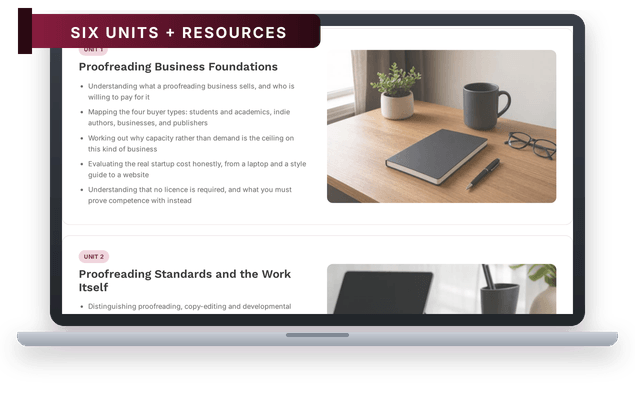
The Fundamentals course teaches that side. Unit 2, Proofreading Standards and the Work Itself, covers working to a style guide, marking up in Track Changes and PDF, and the second-pass habit that meets a professional accuracy standard. Unit 4, Pricing Proofreading for Profit, starts from measuring your own words per hour on real text, which is where proofreading turns from a skill into a service.
Ready to get started?
Our step-by-step courses take you from where you are now to a credential you can show, with templates, an online exam, and a 30-day money-back guarantee.
See the courses