How to start a proofreading business
A complete, no-fluff guide to going from idea to your first paying clients, and then to a business that can grow. Proofreading is one of the cheapest, fastest real businesses to start, and this walks you through every step.
Is a proofreading business worth starting?
Proofreading is one of the most accessible businesses there is. You can do it from anywhere, at hours that suit you, for clients in any country, and the whole of your startup cost can be a style guide and an insurance policy. You do not need a degree, a license, premises or a loan, and the computer you are reading this on is enough to start.
Two things make it different from most first businesses, and both are worth knowing before you start rather than after. The first is that your ceiling is your throughput rather than demand: there is no shortage of text in the world, only a limit to how much of it one person can read properly in a week. The second is that a large share of your working hours will not be billable, because quoting, samples that do not convert, invoicing and the gaps between jobs are all real time nobody pays for. Everything below is built around those two facts.
Step 1: Choose your niche
Trying to offer everything to everyone makes your marketing vague and your reading list impossible. Picking one buyer makes both simpler, and it is the decision every later decision depends on. Here are the three main paths:
| Niche | What it is | Why pick it |
|---|---|---|
| Students and academics | Theses, dissertations and journal articles. | Steady demand, clustered around submission deadlines. Read the institution own policy on what a third party may change before you accept the work. |
| Indie authors | Novels and memoirs, usually self-published. | Long jobs and loyal repeat clients, but lumpier and priced against a personal budget rather than an institutional one. |
| Businesses and agencies | Reports, marketing copy, websites and internal documents. | The most even work across the year and the least deadline-driven, and agencies can become a standing source once you are on their list. |
Most people start with students and academics, because the demand is steady and the jobs are short enough to build a portfolio quickly. You can add business clients later, once you have references and a website worth sending someone to, and a specialty such as legal, medical or technical work later still, once you know the conventions that field expects you to already know.
Step 2: Register and insure your business
Before your first paid job, get the basics in place: register the business, choose a simple structure to start (many begin as a sole proprietor or LLC), and arrange professional indemnity insurance. Insurance matters more than new proofreaders expect, and in this trade it covers a specific thing: the claim that an error you missed cost the client money, which is the one risk the work actually carries. Larger clients and agencies will ask to see it before they send you anything.
You genuinely do not need much money to start, and the small number is itself the argument. Tick the items you will need below to see a realistic launch budget:
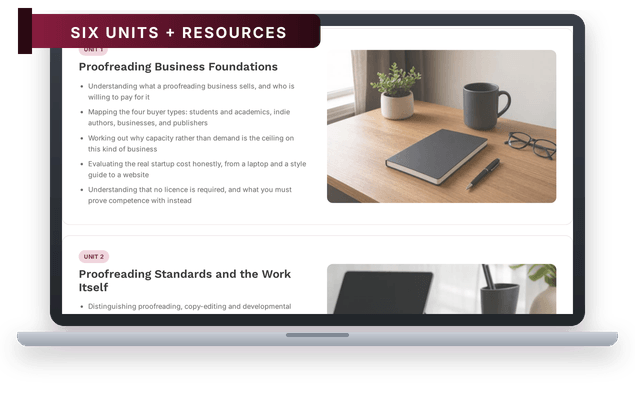
Want the full launch checklist, including registration and the exact kit to buy first? That is Unit 3 of the course, and there is a free startup checklist too.
Step 3: Price your services
Pricing is where new proofreaders most often go wrong: they take a per-word rate off a forum, apply it to a word count, and discover halfway through that the job pays them a fraction of what they intended. The fix is to derive every price from your own measured speed and your own target hourly rate, and to quote from a sample of the actual document rather than from its length.
One thing surprises people coming from other freelance work. Two documents of identical length routinely differ by a factor of two or three in the time they take, so a word count tells you almost nothing about what a job is worth. Assess a representative sample first, time yourself on it, and quote from that. A firm price on text you have not seen is a bet, and it is one you lose often enough to matter.
Try the calculator to get a realistic range for a job:
The course turns this into a repeatable formula and gives you a ready-made rate card template so your rates look professional from day one.
Step 4: Get your first clients
You do not need an advertising budget to get booked, and waiting to be found is the slowest possible start. The fastest first clients almost always come from going directly to them:
- Offer a short test edit. Three hundred words, free, returned quickly. It proves the one thing a stranger actually cares about and no claim about your accuracy can.
- Approach agencies directly. Editorial agencies and proofreading companies keep freelancer lists and are used to being approached. A short covering note and a sample is the whole application.
- Tell everyone you know. The first paid job very often comes from somebody who already knew you, or from one person removed.
- Be listed where your buyer already looks. Directories and marketplaces are competitive, but they are where somebody with a document and a deadline goes first.
- Ask for the testimonial at the right moment. The day you deliver, while the work is in front of them, rather than a month later.
Step 5: Deliver work that earns referrals
Your early clients are your marketing engine, and what turns them into reviews and referrals is consistency: the fortieth job of the month getting the same care as the first. The simplest tool for that is a final-pass checklist covering the error classes that reliably survive a first read, and a style sheet recording every decision the text did not make for you. Both keep your standard steady when you are tired, and both become the training document the day you subcontract.
The details that lose clients are small and specific. Changing something you were not asked to change reads as overreach even when you were right, and it is the fastest way to turn a delivery into an argument. Silently correcting a fact rather than querying it is worse. When in doubt, query it and record the query, which is what the style sheet is for.
See what belongs on a proofreading checklist to keep quality consistent from your very first visit.
Step 6: Grow into a real business
Once you are booked, growth comes from four moves: raise your rates, specialize so you can charge for knowledge rather than only for time, convert one-off jobs into retainers so the year stops being a series of surprises, and eventually subcontract overflow so the work no longer stops when you do. That last step, staying accountable for quality on work you did not do yourself, is what turns a busy job into a business.
The Advanced course covers marketing, systems, hiring, and scaling in depth. If you are curious what the numbers can look like, see how much proofreaders make.
Common mistakes to avoid
- Underpricing. The most common and most damaging mistake. Price from your measured speed, not from fear.
- Quoting from a word count. Assess a sample first. Length tells you almost nothing about how long a document will take.
- Skipping insurance. The claim in this trade is that a missed error cost the client money, and larger clients will ask to see cover before sending work.
- Doing an edit and charging for a proofread. Scope creep here is invisible and it is where the money goes. Say in writing what you will and will not change.
- Planning on billable hours you will not have. Quoting, admin and gaps between jobs are real hours nobody pays for.
- Changing rather than querying. Especially on academic work, where the institution sets rules on what a third party may alter.
- Forgetting to ask for referrals. Happy clients will refer, but usually only if you ask, and the moment to ask is the day you deliver.
Your 30-day action plan
- Week 1: Choose your buyer, pick a name (try the name generator), and register your business.
- Week 2: Arrange insurance, time yourself on three real documents, and set your rates from what you measured.
- Week 3: Build a one-page site, assemble two sample edits you may legally show, and write your test-edit offer.
- Week 4: Make twenty specific approaches, track every reply, and follow up the ones who went quiet.
Follow it and you can realistically have your first paid job inside a month. To do it with a proven system, templates and a certificate behind you, that is what the courses are for.
Start with a clear plan, not guesswork
The Fundamentals course ($247) takes you from idea to your first paying clients, with every template included and a 30-day money-back guarantee.
Frequently asked questions
How do I start a proofreading business?
Decide which buyer you are for, measure how fast you actually proofread, register the business and arrange insurance, set rates from your own measured speed, then approach twenty specific people rather than advertising to everyone. The steps below walk through each one.
How much does it cost to start a proofreading business?
Less than almost any other business, which is genuinely the appeal. A computer you already own, a current style guide, professional insurance, a domain and optional software covers it, and the total is usually in the hundreds rather than the thousands. Use the startup cost calculator on this page to add up your own list rather than trusting an average.
Do I need a qualification to be a proofreader?
No. There is no licensing body for proofreading and no legal barrier to charging for it. That cuts both ways: nothing stops you starting, and nothing vouches for you either, so competence has to be demonstrated with a sample edit rather than asserted with a certificate. Bodies such as the CIEP offer membership and training, but they do not license the profession and nobody can.
How do I get my first proofreading clients?
Choose one buyer type and go directly to them rather than waiting to be found. Offer a short test edit, which proves the thing a stranger actually cares about, and follow up on the ones who do not reply. Twenty specific approaches beats a hundred generic ones.
Is a proofreading business profitable?
It can be, and the thing that decides it is usually utilization rather than your rate: the share of your working hours somebody actually pays for, once quoting, admin and the gaps between jobs are counted. See how much proofreaders make for the detail.
Ready to get started?
Our step-by-step courses take you from where you are now to a credential you can show, with templates, an online exam, and a 30-day money-back guarantee.
See the courses