Do You Need a Qualification to Be a Proofreader?
The short answer is no. There is no licensing body for proofreading, no legal barrier to charging for it, and nobody who can stop you calling yourself a proofreader tomorrow morning. That is true in the United States, the United Kingdom, Australia and almost everywhere else.
People usually hear that as good news and stop there. It is worth going one step further, because the same fact that lets you start also decides how you will have to sell.
What "no gatekeeper" actually means
In a licensed trade, the license does two jobs. It keeps people out, and it vouches for the people it lets in. A client hiring a licensed professional does not have to assess competence themselves, because somebody else already did.
Proofreading has neither half. Nothing keeps anyone out, so your competitors include everybody who has ever been told they are good at spotting typos. And nothing vouches for you, so a client has no shortcut for telling you apart from them.
That is the real problem to solve, and it is not solved by a certificate. It is solved by evidence.
What about the CIEP, and bodies like it?
The Chartered Institute of Editing and Proofreading in the UK, and equivalent organizations elsewhere, are membership bodies. They offer training, standards, a directory and a community, and membership at their higher grades genuinely signals something, because it is assessed.
What they are not is a license. They do not regulate the profession, they cannot stop a non-member working, and no client is obliged to care. Membership is a useful credential among several, not a permission slip.
We should be equally plain about our own certificate. It says you completed this course and passed its examination. It is a private credential from a private institute. It is not a degree, not a license, and not membership of any professional association, and anybody who tells you a certificate of any kind is required to work as a proofreader is selling you something.
So what does get you hired?
In practice, one thing above all others: a sample edit. Three hundred words, done well, returned quickly. It answers the only question the client actually has, which is whether you are any good, and it answers it in a way no claim about accuracy can.
Beyond that, in rough order of how much they matter:
- Evidence of the work itself. Samples you may legally show, and a clear account of what you changed and why.
- Knowing a style guide properly. Naming the guide and the dictionary you work to marks you out immediately from somebody who proofreads by instinct.
- A specialty. Somebody who spent ten years in medicine, law or engineering can proofread in that field with a confidence a generalist cannot, and that is what the higher rates are paid for.
- Reliability. Unglamorous, and the single most common reason agencies keep using someone.
- Training and credentials. Real, and last on the list on purpose.
Then why take a course at all?
For the same reason you would take one in anything else: to get good faster, and to skip the expensive mistakes. The costly errors in this trade are not spelling errors. They are quoting from a word count, agreeing a scope you did not define, changing something you were not entitled to change, and setting a rate before you know how fast you read.
None of those is fixed by being told commas are important. They are fixed by working through the decisions once, deliberately, before a paying client is on the other end.
Take the training for the competence. Treat the certificate as what it is: a reasonable thing to list, and never the thing that wins you the work.
Ready to get started?
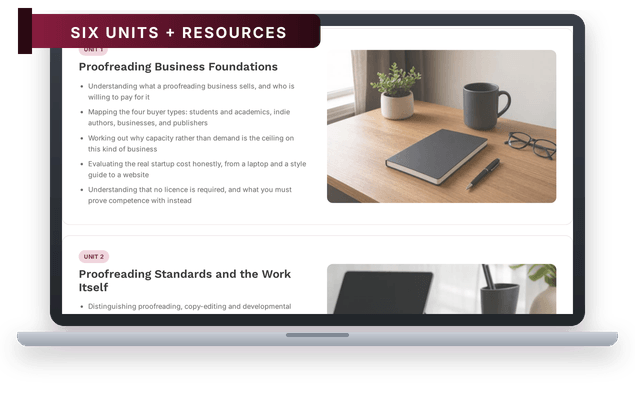
Our step-by-step courses take you from where you are now to a credential you can show, with templates, an online exam, and a 30-day money-back guarantee.
See the courses