Are Online Proofreading Jobs Legit?
Yes, online proofreading jobs are legit when the client pays you for finished work. Publishers, agencies, businesses and authors hire remote proofreaders every day. The scams are the offers that turn that around and ask you to pay first, for a "registration fee", a test, a starter kit or a certificate the company itself issues, before any paid work exists.
That single test, which way the money moves, sorts most offers in seconds. The rest of this guide covers where real online proofreading work comes from, the schemes that imitate it, the warning signs in an advert or email, and how to check a client or platform before sending a single file back.
Where legitimate online proofreading work comes from
Real remote proofreading work exists in several forms, and each has its own normal way of hiring. Knowing what normal looks like is the fastest way to spot an offer that is not. Our guide on how to get proofreading jobs covers each route in depth, so this is the short version.
The legitimate routes include:
- Direct clients. Authors, small businesses, students and academics who find a proofreader through a website, a referral or a directory and pay them per job.
- Editorial agencies. Companies that take work from their own clients and pass it to a pool of freelancers, usually after a short skills test.
- Freelance marketplaces. Open platforms where clients post jobs and freelancers bid, with the platform taking a commission from what the freelancer earns.
- Publishers and in-house teams. Publishing houses, newspapers and corporate communications teams that keep a list of trusted freelancers or hire salaried staff.
- Professional bodies. Some run job boards for members, such as the Editorial Freelancers Association's job list, where clients post work directly.
Notice what these have in common. Money flows from the client to the proofreader, or from the client to a platform that takes a cut of the proofreader's earnings. A marketplace commission or a professional body's membership fee is a known, published cost of doing business. Neither is a condition of being offered a particular job.
The schemes that imitate proofreading jobs
Scammers copy proofreading because it sounds easy, needs no equipment and can plausibly be done from anywhere. The schemes come in a few recurring shapes, and they often blend into one another.
- Pay to join
- A site promises access to a stream of proofreading jobs once you pay a sign-up or membership fee, and the jobs never arrive or pay pennies.
- Test fee
- You are told you have passed an application and must pay to sit the "qualifying test", or to have your test marked.
- Own certificate
- The company will only hire people holding its own paid certificate, sold to every applicant and recognized by nobody else.
- Overpayment
- A new "client" sends a check for more than the fee and asks you to send the difference back before the check bounces.
- Data harvest
- An application asks for a bank account, Social Security number or ID scan before any interview or contract.
The overpayment scheme deserves a closer look, because it fools careful people. The check clears into the account at first, so the money appears real. Days later the bank finds it is counterfeit and reverses it, and the person who wired back the "extra" has lost that money for good.
Training sold honestly as training is a different thing. A course with a published price, a stated syllabus and a refund policy is a purchase you choose to make, like any other. The problem arises only when payment is presented as the price of a job, which is how pay-to-join and own-certificate schemes work.
How common the schemes have become
Fake job offers are not a fringe problem. Here at the Proofreading Institute, the number of suspect proofreading job offers students have forwarded to us for a second opinion has roughly tripled over the last four years. The pattern matches what consumer agencies report about fake job offers in general, which have become one of the faster-growing kinds of fraud.
Warning signs in a proofreading job offer
Most fake offers give themselves away in the first message, if a reader knows what to look for. The Texas Attorney General's guide to common scams warns that jobs requiring payment upfront for training or equipment, or that send checks to deposit, are often scams, and that a job which is easy to get, pays very well and needs little work should raise suspicion.
Applied to proofreading, the warning signs include:
- being offered work without a test, a sample edit or any conversation about experience
- a request for any payment, of any size, before the first paid job
- pay promised by the hour at a rate far above what professional surveys report, for "no experience needed"
- a recruiter who contacts you first, through a text or a messaging app, about a job you never applied for
- a company email on a free webmail address, or a website with no named people, address or terms
- pressure to decide today, or a "limited number of places" on a job
- a request to move payment off the platform where the job was posted
Pay is the easiest of these to check against a benchmark. The Editorial Freelancers Association publishes survey medians for proofreading, and our guide to how much proofreaders charge sets them out. An advert promising several times those rates to beginners is describing something other than proofreading.
How to check a client or platform before you start
A warning sign is a reason to look harder, not proof of a scam. Plenty of real clients write clumsy first emails. The checks below take about half an hour and settle most doubts before any work is done.
- 1
Confirm who they are
Find a named person, a physical address and a working phone number, and check them against a business registry or a publisher's own site.
- 2
Search the name with the word scam
Search the company name, the contact's email address and any phone number, alongside words such as scam, complaint or review.
- 3
Check the contact came through you
Make sure the first contact traces back to a job you applied for, or to a referral you can confirm with the person named.
- 4
Read the terms before the test
Look for written terms covering pay, payment timing and what happens to a test edit, and treat their absence as a reason to ask.
- 5
Agree payment in writing
Settle the fee, the deadline and how payment will be made before starting, and take a deposit on a large job from a new client.
The order matters less than the habit. A real agency or author expects a professional to ask these questions, and answers them without fuss. A scammer tends to push past them, change the subject to money or stop replying.
Checking freelance platforms
Open marketplaces are legitimate, but scammers use them too. The rule there is simple. Keep every conversation and every payment on the platform, because its payment protection only covers work it can see. A client who asks to move to a messaging app or pay outside the platform has usually given the game away.
What a legitimate proofreading test looks like
Tests are normal, and their existence is not a warning sign. Agencies and many direct clients ask a new proofreader to work on a short passage, often with errors planted in it, before offering work. A good test is short, free to sit, and marked against a clear standard.
The differences between a real test and a fake one are easy to see side by side.
- A real test is free. A fake one charges to sit it, mark it or "certify" the result.
- A real test is a few pages at most. A fake one is a whole document the client needs proofread for free.
- A real test leads to an offer or a polite no. A fake one leads to a request for money or personal details.
The middle point catches people who are otherwise careful. Some clients ask for a "test" that is really a full chapter or an entire website. Offering a short free sample of a few hundred words is reasonable. Proofreading a full manuscript as a test is unpaid work, whatever it is called.
What to do if you have already paid
Anyone who has already paid a fee or sent money back on a check should act quickly, because speed is what gives a bank any chance of recovering it. Contact the bank or card provider first, explain that the payment was made to a scam, and ask about disputing or recalling it.
After that, report it. In the United States, reports go to the Federal Trade Commission at ReportFraud.ftc.gov, and online fraud can also be reported to the FBI's Internet Crime Complaint Center. A report rarely brings money back on its own, but it helps investigators connect cases, and it records the loss if a bank later asks.
Change any password shared with the "employer", and watch the account for unfamiliar charges. If a Social Security number or ID was sent, treat it as an identity theft risk and act on that too.
Finding real proofreading work with confidence
The best protection is a clear picture of how real work is found, so that a fake offer looks wrong at once. Our guide to becoming a proofreader with no experience covers building the portfolio and practice record that real clients ask for.
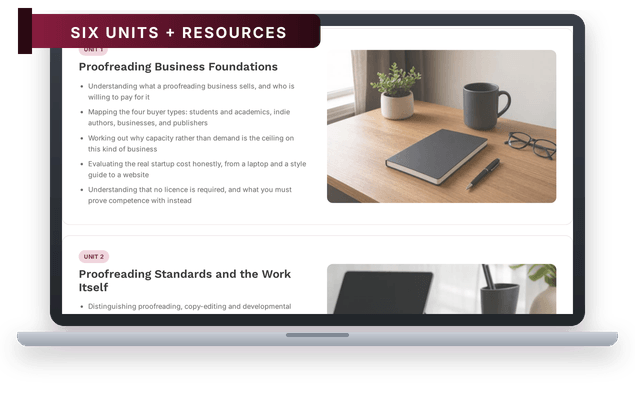
The Fundamentals course goes further. Unit 6, Getting Your First Clients, covers choosing one buyer type and approaching clients directly, which removes most of the exposure to unsolicited offers. Unit 3, Setting Up Your Business, covers terms of service, taking payment safely from clients abroad, and handling a client's manuscript responsibly.
Ready to get started?
Our step-by-step courses take you from where you are now to a credential you can show, with templates, an online exam, and a 30-day money-back guarantee.
See the courses