How to Become a Proofreader With No Experience
To become a proofreader with no experience, build the evidence that experience would otherwise provide. That means timed practice on real text until your accuracy and pace are known, a small portfolio of before-and-after samples, and a direct approach to one kind of client, starting with small paid jobs and asking each one for a reference.
No license or qualification is needed to start, and our guide to proofreading qualifications covers what each credential does and does not signal. This guide is about the other half of the problem, which is how a beginner shows a stranger that they can do the work before anyone has paid them to.
What experience means to a proofreading client
A client who asks about experience is rarely asking how many years someone has worked. They are asking three narrower questions. Will this person catch the errors? Will they leave the correct text alone? Will the file come back on time, in a form the client can use?
Salaried roles answer those questions with a work history. The O*NET profile of proofreaders and copy markers places the occupation in its Job Zone Four, where several years of work-related experience or training are usual. Freelance clients are more flexible, because they can judge a sample, a test edit or a reference directly.
That is why a beginner's plan has three parts, and they run in order. Skill comes first, because a portfolio built on weak work does harm. Proof of the skill comes second. Clients come third, and the first few are chosen for the reference they will give as much as for the fee.
Practice work that builds real skill
Practice only counts if it resembles paid work. Reading a novel and noticing typos is not practice. Practice means taking a document, agreeing a standard to check it against, marking every error, and timing how long it took.
Good sources of practice text include:
- your own old writing, such as essays or reports, left alone for a few weeks so it reads as someone else's
- documents from friends, family or a local club, proofread for free in return for permission to describe the work
- public-domain books, retyped in a short passage with errors planted by a friend who keeps the answer key
- a volunteer newsletter, a community group's website or a small charity's annual report
- the practice exercises in a proofreading course or textbook, which come with marked answers
The answer key is what makes practice useful. Without one, a beginner only learns what they found, never what they missed. A friend who plants twenty errors in a page and keeps the list gives a far better test than any amount of unmarked reading.
Timing practice against a professional pace
Speed is the half of practice most beginners skip, and it decides whether paid work will pay. The Editorial Freelancers Association's rate chart reports median proofreading paces of 10 to 15 pages an hour for fiction and 7 to 12 for nonfiction, with a page counted as 250 words.
Beginners usually start well below that range. Here at the Proofreading Institute, students timing their first practice proofreads over the past year have managed about half the pace that experienced proofreaders report for fiction.
A slow start is normal and it improves with practice, but it changes how a beginner should quote. Here is how one practice timing works through, as an illustration.
The same book takes this beginner twice as long, so a fee set from the published pace would pay half the hourly rate it seems to.
The lesson is not to work faster by skimming. It is to know your own pace before quoting, and to price early jobs knowing that each one will take longer than it will a year from now. Accuracy has to hold steady as the pace rises, and an answer key is the only way to know that it has.
Building a portfolio without a client list
Once practice is producing accurate work, it can become a portfolio. A proofreading portfolio is a short set of samples that show a stranger what you catch and how you mark it. Three or four strong samples beat a dozen weak ones.
Each sample works best as a matched pair, a short passage before and after, with a line explaining the brief. The pieces that make a beginner's portfolio convincing include:
- a before-and-after passage of about a page, with the corrections visible as tracked changes or comments
- a short style sheet for that passage, recording the spellings and conventions applied, built from our proofreading style sheet template
- one sample in the format of the client you want, such as a PDF proof for publishers or a Word file for authors
- a one-line note on each sample saying what it was and that it is shared with permission
Permission is the part beginners forget. A friend's report or a charity's newsletter belongs to them, and sharing it without asking breaches the confidence a proofreader is trusted with. If permission is not given, retype the passage with names and details changed, and say so on the sample.
A short résumé or profile should sit beside the samples. Our freelance proofreader résumé template shows how to lead with skills and samples rather than with job titles a beginner does not yet have.
Finding the first paying clients
With samples in hand, the first clients come from approaching people rather than waiting for them. A beginner competing on open job boards against hundreds of established profiles has few advantages. A beginner writing directly to a dozen people of one type, with a sample made for them, has several.
- 1
Choose one buyer type
Pick a single kind of client, such as self-publishing romance authors, graduate students or local small businesses.
Hands on a clear target - 2
Make one sample for them
Add a sample in that client's format and genre, so they can see their own kind of work done well.
Hands on proof they recognize - 3
Approach them directly
Write a short, specific message to ten or twenty of them each week, offering a free sample edit of a page.
Hands on replies and sample requests - 4
Take small paid jobs
Accept short documents first, deliver them early and cleanly, and send a brief summary of what was changed.
Hands on satisfied clients - 5
Ask for a reference
Ask each happy client for a sentence you may quote, and whether they know anyone else who needs a proofreader.
The free sample edit in step three is the single most useful tool a beginner has. It lets a client judge the work on their own text, which answers the experience question better than any history could. Keep it to a page or two, so it shows skill without becoming unpaid work.
Our pillar guide on how to become a proofreader covers choosing a niche and a 30 to 60 day plan in more detail, and the same buyer-first approach runs through it.
Mistakes that slow a beginner down
Most beginners who stall do so for the same few reasons, and each one is avoidable. The common ones are:
- practicing without an answer key, so missed errors never show up
- quoting by word count from a published rate without first timing their own pace
- editing rather than proofreading, by rewriting correct sentences to sound better
- trying to appeal to every kind of client at once, so no sample fits anyone
- paying for "job access" schemes instead of approaching clients directly
The third mistake is the one clients notice first. A proofreader who changes a writer's correct sentences has done a different job from the one agreed, and often a worse one. Learning to leave correct text alone is as much a skill as catching errors.
Learning the skills in order
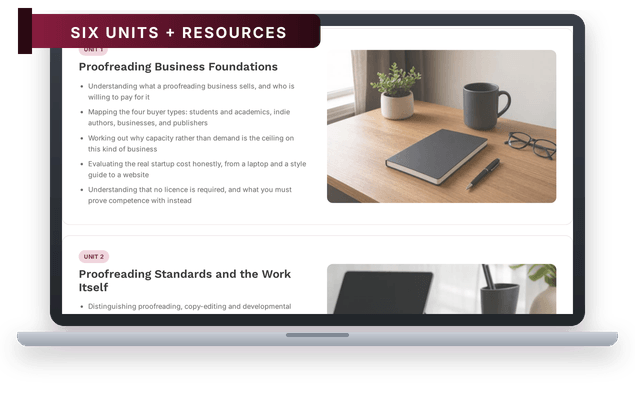
The Fundamentals course follows the same order as this guide. Unit 2, Proofreading Standards and the Work Itself, covers marking up work and where proofreading stops.
The business side follows. Unit 4, Pricing Proofreading for Profit, shows how to measure your own speed and quote from a sample rather than a word count. Unit 6, Getting Your First Clients, covers choosing one buyer type and building the proof a stranger needs.
Ready to get started?
Our step-by-step courses take you from where you are now to a credential you can show, with templates, an online exam, and a 30-day money-back guarantee.
See the courses